Windows patching sounds simple until you try to do it on a vessel.
The update still needs to arrive. It still needs to install. And it still needs to happen without consuming an unreasonable share of the ship's monthly bandwidth.
That is where the quota question starts.
Windows updates keep getting heavier
For many shore-based environments, larger update packages are mostly an inconvenience.
For vessels, they can become a planning issue very quickly.
Microsoft's April 14, 2026 cumulative update for Windows 11 version 24H2 x64, KB5083769, is listed in the Microsoft Update Catalog at 5116.0 MB.
That is a useful real-world example because once a single monthly update reaches the 5 GB range, the question is no longer just:
Should this system be patched?
It becomes:
Can we move this amount of data onboard without disrupting everything else?
That is a very different operational question.
The math breaks fast on VSAT and shared Starlink
If a single Windows 11 update is about 5 GB and a vessel has 8 PCs to maintain, unmanaged delivery can turn into roughly 40 GB of traffic surprisingly fast.
That is not a small background process.
It is a meaningful percentage of the vessel's available data budget, especially where business traffic, crew welfare traffic, and security tooling are all competing for the same link.
Even on Starlink, that volume is not trivial.
Many vessels operate on monthly Starlink packages in the 50 GB to 200 GB range, sometimes higher, but that allowance is usually shared.
In practice, crew welfare traffic often takes a substantial portion of the total package, which can leave 50 percent or less available for business operations.
Seen in that light, 40 GB of Windows update traffic is not background usage. It is a very large share of the vessel's usable business bandwidth for the month.
As an illustration, 40 GB of update traffic would take roughly 6 hours to transfer at a sustained 15 Mbps download rate, assuming the link could be largely given over to Windows Update during that period.
In practice, that is exactly the problem.
You usually do not want update traffic consuming that much of the available pipe because it can affect mail flow, cloud applications, remote support activity, and general business connectivity onboard.
The default update model is not built for maritime reality
Mainstream update workflows usually assume:
- stable connectivity
- generous bandwidth
- low concern about transfer timing
- little penalty for retrying large downloads
Those assumptions are weak offshore.
At sea, failed or partial update attempts are not just annoying. They can waste airtime, delay progress, and make patch status harder to predict.
A9X removes the duplicate download problem first
This is where A9X Windows Update changes the economics immediately.
Without A9X, that 5 GB update may be pulled separately by each PC.
With A9X, the vessel only needs one transfer of roughly 5 GB, after which the update can be distributed locally onboard.
That alone is a major reduction in airtime use.
But for many VSAT vessels, and even for some business-critical Starlink environments, a single 5 GB transfer is still larger than teams want to move in one shot.
Quota-based control matters more than raw automation
Good maritime patching is not only about reducing duplicate traffic.
It is also about controlling how large updates move over time.
That is why A9X exposes a monthly vessel quota rather than leaving bandwidth use to chance.
That means operators need a way to:
- limit how much update data is transferred each month
- avoid sudden bandwidth spikes
- preserve progress already downloaded
- keep working toward full patch completion over time
Without that control, patching can become erratic and expensive.
Hunking is now available
Hunking is now available in A9X Windows Update.
It is a practical way to deliver very large Windows updates across multiple months, or across smaller controlled windows within a month, instead of forcing the whole package through in one go.
An administrator can define a monthly vessel quota for Windows Update traffic, and A9X then works within that limit.
If an update is larger than the available budget, the transfer is broken into controlled parts.
For example, with a 2 GB allowance, a 5 GB-class update can be delivered in three stages rather than trying to consume the whole amount immediately.
That can be used in two useful ways:
- to stay under a strict monthly VSAT allowance
- to spread transfer over time on Starlink so business traffic is not clogged by a single large download
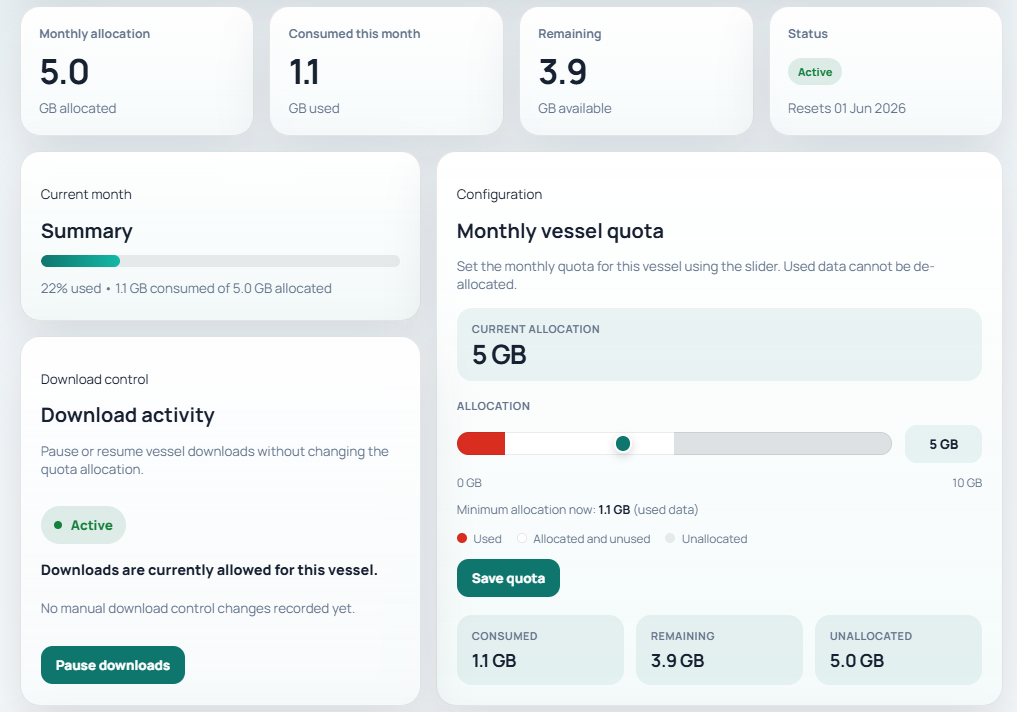
If a vessel is allocated 5 GB for the month and has already consumed 1.1 GB, that consumed amount becomes the practical floor for the current period. Operators can still increase, pause, or manage delivery, but they are not working blind.
Partial progress should not be wasted
One of the biggest frustrations with constrained environments is downloading a large amount of data and then losing the benefit of that progress.
A stronger model is to keep the selected update in focus, retain what has already been transferred, and continue until the full update is ready to install.
That changes the process from:
- repeated failed attempts
- repeated bandwidth usage
- uncertain completion timelines
to something much more manageable:
- steady monthly progress
- predictable airtime consumption
- eventual successful installation
The dashboard makes the quota visible
Operationally, the value is not just the quota itself.
It is being able to see the quota and the current usage clearly.
The A9X dashboard shows:
- monthly allocation
- consumed this month
- remaining quota
- vessel download status
It also allows teams to pause or resume downloads without changing the quota itself.
That makes planning easier for both technical and operational stakeholders.
Real-time usage tracking gives teams a clearer view of what is being consumed and when, which is exactly what is missing from generic Windows Update workflows.
Better patching at sea is usually slower, but smarter
This is one of the important differences between shore-based and maritime IT.
Onshore, speed is often treated as the main metric.
Offshore, the better metric is controlled completion.
If a vessel can move toward patch compliance in a predictable way without exhausting bandwidth or interrupting higher-priority traffic, that is usually the better outcome.
Bottom line
Large Windows updates are now a bandwidth management problem as much as a patching problem.
For vessels operating over VSAT or other constrained links, staged delivery gives operators a more realistic way to stay on track.
Instead of trying to force oversized updates through a narrow pipe all at once, the better approach is to reduce duplicate downloads, manage a clear monthly vessel quota, move the remaining data deliberately, preserve progress, and finish the job over time.
Source example: the 5116.0 MB size for the April 14, 2026 Windows 11 version 24H2 x64 cumulative update KB5083769 is taken from the Microsoft Update Catalog. The related Microsoft support article is here.